




The Denisov‑Uralsky Ural Emerald Necklace
An Imperial-Era Russian Masterpiece — Documented, Exhibited, and Attributed

Overview
This historic pendant necklace, centered by an exceptionally large Ural emerald exceeding 40 carats, is attributed to Russian artist, lapidary, and designer Alexey Denisov-Uralsky (1864–1926). Created during the final years of the Russian Empire, the necklace represents one of the most complete and thoroughly documented surviving examples of Denisov-Uralsky’s rare jewelry production.
In 2024, the necklace was exhibited by the Sverdlovsk Regional Museum of Local History, one of Russia’s principal institutions devoted to Ural cultural heritage. The piece is further cited and analyzed in a peer-reviewed scholarly study published in Art of Eurasia (2024) by researchers affiliated with Saint Petersburg Mining University, where it is recognized as a significant surviving work aligned with Denisov-Uralsky’s documented jewelry practice.
About the Necklace

Denisov-Uralsky, famed for his advocacy of Ural gemstones, designed this piece to glorify the natural beauty of Russian emeralds—a philosophy he championed in exhibitions from St. Petersburg to Paris.
- Emerald: Ural origin, approx. 40 carats (22.98 × 21.70 × 10.24 mm)
- Mount: Gold & Platinum
- Diamond Accents: 13 antique-cut stones (pear, marquise, trilliant)
- Length: 6¾ inches (17.15 cm)
- Workshop: Sixth Jewelry Artel, St. Petersburg
- Dating: 1914–1917, confirmed by hallmarks and fitted case
- Retail Mark: Original fitted case bearing Petrograd-era shop stamp, “27 Bolshaya Morskaya”
- Certification: AGL (American Gemological Laboratories)
- Exhibition: Sverdlovsk Regional Museum of Local History (2024)
- Citation: Borovkova & Sukhareva, Art of Eurasia (2024)
This necklace provides an uncommonly intact and well-documented glimpse into Denisov-Uralsky’s legacy. The scale of the emerald, the distinct Russian setting, and the verified wartime hallmarking collectively position the piece as a benchmark of the artist’s oeuvre.
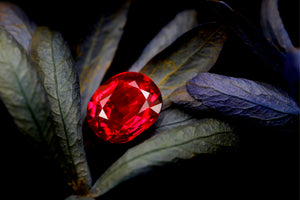
The emerald is notable not only for its scale, but for its distinctly "Ural" character. Broad-faced and powerful in presence, the stone displays a deep, saturated green with subtle tonal variation typical of historic Russian material. The cut emphasizes mass, depth, and color integrity, allowing the emerald to dominate the composition. The surrounding diamond accents and restrained gold-and-platinum framework function architecturally – designed to support the gemstone without competing for attention, in keeping with Denisov-Uralsky’s principle of the primacy of stone.
Inquire about this magnificent piece of jewelry history here.
Historical Background: Alexey Denisov‑Uralsky
Alexey Denisov-Uralsky was born in Yekaterinburg into a family closely connected to the stoneworking traditions of the Urals. Trained initially through practice and later through formal artistic study in St. Petersburg, he developed a multidisciplinary career encompassing painting, stone sculpture, jewelry design, and mineral advocacy.
From the late 19th century onward, Denisov-Uralsky pursued a deliberate artistic program centered on the “primacy of stone”—the idea that natural material, particularly Ural gemstones, should serve as the conceptual and visual core of an object. This principle governed both his sculptural works and his limited jewelry output, which often featured unusually large stones within restrained settings.
By the early 20th century, Denisov-Uralsky operated a workshop and retail space in St. Petersburg, ultimately located at 27 Bolshaya Morskaya Street, where he sold objects created from his own designs. Lacking a personal maker’s stamp, he collaborated with established Petersburg artels to execute his jewelry, a common practice that later complicated attribution.
The First World War and subsequent Russian Revolution proved catastrophic. Denisov-Uralsky’s workshop and holdings were dispersed or dismantled, and much of his jewelry production was lost, dismantled, or undocumented. As a result, securely attributed and well-documented jewelry by Denisov-Uralsky is rare; surviving examples are primarily held in museum collections or preserved through exceptional documentary circumstances.
Documentation and Scholarly Study
In recent years, renewed scholarly attention has clarified Denisov-Uralsky’s jewelry practice through the study of archival invoices, drawings, and workshop records preserved by the Mining Museum of Saint Petersburg Mining University. These materials formed the basis of a 2024 peer-reviewed study that reconstructed aspects of Denisov-Uralsky’s lost jewelry production and established stylistic and technical benchmarks for attribution.
The present necklace is cited within this research and aligns closely with Denisov-Uralsky’s documented design principles, including large central stones, openwork construction, and restrained metal treatment.

Because so much of his jewelry production was dispersed or lost during the Revolutionary period, well-documented surviving examples are scarce. This necklace is exceptional not only for the scale of the emerald, but for its documentation, fitted case markings, and institutional exhibition record.
Provenance
- Attributed to: Alexey Denisov‑Uralsky
- Date: c. 1914–1917
- Retail Mark: Original case with Petrograd-era shop stamp
- Certification: AGL
- Provenance: Bernard & Ruth Madoff Estate (2016)
- Exhibited: Sverdlovsk Regional Museum of Local History (2024-2025)
- Cited in: Art of Eurasia (2024)

Scholarly Endorsement
“A rare surviving example of Denisov‑Uralsky's early 20th-century jewelry work using Ural emeralds... a piece of museum significance in private hands.”
— Natalia Borovkova, PhD & Zlata Sukhareva
Saint Petersburg Mining University

Aleksey Kuzmich Denisov-Uralsky (1890s)
Inquiries
Available by private appointment only.

Email: info@assayjewelers.com